


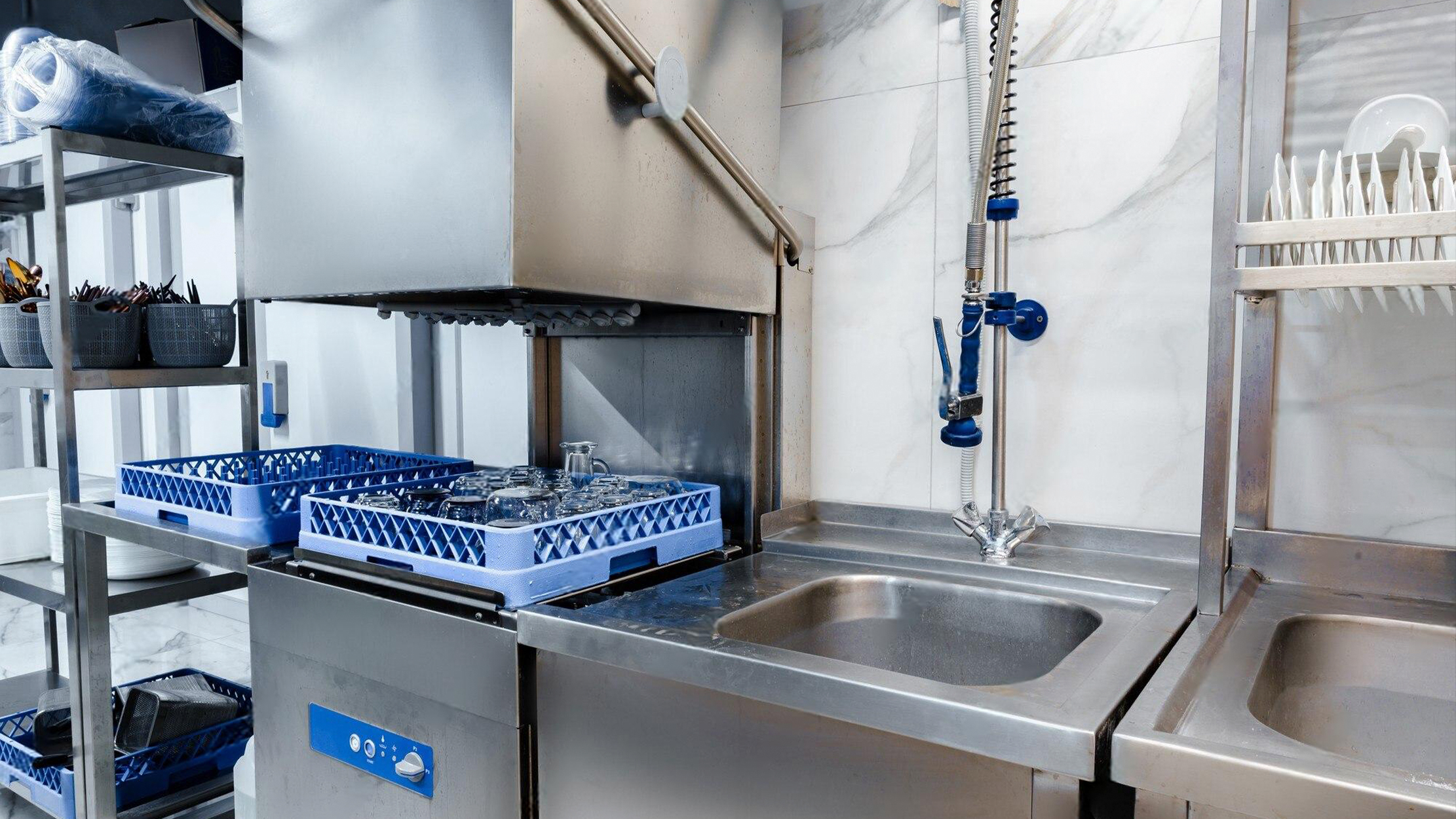
In the hospitality and restaurant industry, the industrial dishwasher is an essential piece of equipment to ensure efficient and consistent dishwashing. Unlike domestic dishwashers, these machines are designed to operate continuously in high-demand environments, optimizing both time and resource consumption.
Using an industrial dishwasher enhances the operational efficiency of a professional kitchen by reducing manual workload and ensuring optimal hygiene through the use of high temperatures and specialized cleaning products. Additionally, its integration into kitchen workflows contributes to a smoother and more organized process, minimizing wait times and improving the customer experience.
To ensure proper operation and extend its lifespan, it is essential to use detergents formulated for different water types, specialized rinse aids, and maintenance products that prevent residue and scale buildup. This article will cover the different types of industrial dishwashers, their operation, best maintenance practices, and the most suitable products to optimize their performance.
1. Types of Industrial Dishwashers
The choice of the right industrial dishwasher depends on several factors, such as the volume of dishes to be processed, the kitchen layout, and the frequency of use. There are different types of dishwashers designed to meet specific needs within the food service and hospitality industry.
- Undercounter Dishwasher
This model is ideal for establishments with a moderate washing volume, such as cafés, bars, or small restaurants. Its compact design allows for installation in limited spaces without compromising washing efficiency. It features fast cycles and optimized water and detergent consumption.
- Hood-Type Dishwasher
Suitable for restaurants with a high washing volume, this type of dishwasher allows for quick loading and unloading through a hood-lifting system. Its design facilitates a continuous workflow, optimizing washing times and reducing staff effort.
- Conveyor Dishwasher
Used in industrial kitchens and large dining facilities, this type of equipment operates with a conveyor belt system that moves dishes through different washing and rinsing phases. It is ideal for environments with a high demand for constant dish processing.
- Dome Dishwasher
Known for its capacity and washing speed, this dishwasher features a top-loading system that optimizes water and cleaning product distribution, ensuring a uniform wash. It is designed to facilitate the handling of large volumes of utensils in high-performance kitchens.
2. Operation and Key Features
The operation of an industrial dishwasher follows a series of phases that ensure the efficient removal of dirt and organic residues:
- Pre-Wash: Large food particles and debris are removed through an initial rinse.
- Detergent Wash: A specialized detergent is applied along with hot water, typically between 55°C and 65°C, to dissolve grease and grime.
- Rinse with Rinse Aid: Water at higher temperatures (up to 85°C) is used along with a rinse aid to prevent streaks and facilitate drying.
- Drying: In many models, drying occurs through residual heat from the rinse cycle, speeding up the process without manual intervention.
The dishwasher’s performance depends on factors such as water pressure, proper dosing of detergent and rinse aid, and regular maintenance of the filtration system and spray arms.
Key Considerations for Optimizing the Washing Process:
- Deactivating Detergent When Using a Descaler: When using a descaler in an industrial dishwasher, it is essential to deactivate the detergent function. This prevents both chemical solutions from interacting simultaneously, which could cause unwanted reactions, affecting both the wash quality and the integrity of the equipment.
- Optimal Loading and Preventing the Umbrella Effect: One of the most common mistakes in using industrial dishwashers is improper overloading. It is crucial to distribute utensils correctly to avoid the umbrella effect, where stacked plates, glasses, or containers block water and detergent from reaching all surfaces evenly. This can lead to dirt from one item falling onto another, compromising the hygiene of the wash.
- Separating Dishware and Glassware: Whenever possible, it is recommended to separate dishware from glassware inside the dishwasher. Glass items are more delicate and can be damaged if mixed with plates, cutlery, or heavier utensils. Additionally, this separation helps optimize the washing process for each material type and reduces the likelihood of residue or stains on glasses and cups.
3. Maintenance and Cleaning of Industrial Dishwashers
Proper maintenance is essential to ensure the dishwasher’s performance and prevent breakdowns that could affect business operations. Maintenance tasks can be divided into several categories:
Daily Maintenance
· Cleaning filters to prevent blockages.
· Checking spray arms to ensure proper water distribution.
· Draining and cleaning the water tank to avoid grease and detergent buildup.
· Using appropriate cleaning products based on water hardness and soil level.
Weekly and Monthly Maintenance
· Cleaning seals and gaskets to prevent water leaks.
· Checking detergent and rinse aid levels in the dispensers.
· Applying descaling products to remove limescale deposits in pipes and heating elements.
· Inspecting hoses and connections to prevent leaks or component deterioration.
Long-Term Maintenance
· Annual technical inspection by a professional to identify worn-out parts.
· Replacing key components such as filters, spray arms, and seals.
4. Recommended Cleaning Products for Industrial Dishwashers
Using specialized cleaning products is essential to ensure effective cleaning and prevent issues caused by residue buildup. These products can be categorized based on their function:
- Detergents
Industrial dishwasher detergents are formulated to work with different water types:
· For very hard water: Contain anti-scale agents to prevent mineral deposits (Deterplus).
· For hard water: Designed to minimize limescale buildup and improve washing performance (Deterdur).
· For semi-hard and soft water: Optimized for effective cleaning without leaving calcium residues (Deternet, Deternet+).
· Chlorinated detergents: Provide disinfecting action for removing persistent organic residues (Deterclor).
· Powder detergents: A solid alternative that allows greater control over dosing (Supersol).
· Special-purpose detergents: Formulated for specific washing needs (Deter Al).
- Descalers
Descalers are designed to quickly remove limescale and mineral deposits that can affect the dishwasher’s performance and washing quality. Their use is particularly recommended in areas with hard or very hard water, where limescale buildup in heating elements and pipes can reduce the machine’s efficiency (Detercal).
- Rinse Aids
These products facilitate drying and prevent streaks on dishware. Different formulations are available based on water type:
· For very hard and hard water: Contain specific agents to prevent calcium residues (Deterdry, Deterbrill).
· For semi-hard and soft water: Designed to ensure a spotless finish (Detersec, Detersec K).
· For demineralized and osmosis-treated water: Specially formulated for environments with water treatment systems (Osmonet, Osmosec, Osmosec R).
Using the right products is essential to ensure effective cleaning, extend the lifespan of industrial dishwashers, and optimize water and energy consumption. Depending on the specific needs of each establishment, there are different product formulations available to achieve the best results.
Conclusion
The industrial dishwasher is a key investment in the efficiency of any hospitality or restaurant business. Its proper operation depends not only on the use of appropriate cleaning products but also on regular maintenance to ensure optimal performance and extend its lifespan.
Using specialized detergents, tailored rinse aids, and maintenance products helps optimize the washing process and prevent issues caused by limescale and residue buildup. Additionally, establishing regular cleaning and monitoring routines contributes to minimizing water and energy consumption, ensuring greater operational sustainability.